Designing a Custom New Build in Northern Virginia: Where to Start

There is a particular kind of excitement that comes with building a custom home. The land is yours, the program is yours, the opportunity to make every decision exactly right feels, for a brief and intoxicating moment, completely within reach. Homeowners in McLean, Great Falls, Vienna, and across the wider Northern Virginia corridor arrive at this process with more resources, more intention, and more genuine design curiosity than at any previous point in the luxury residential market. And a significant number of them still end up, twelve to eighteen months later, living in a home that almost works — that is beautiful in photographs and subtly frustrating in person.
The reason is almost never the architect. It is almost never the builder. It is the sequence in which decisions got made — and, more specifically, the window in which the most consequential decisions were either made thoughtfully or defaulted to whoever was in the room at the time.
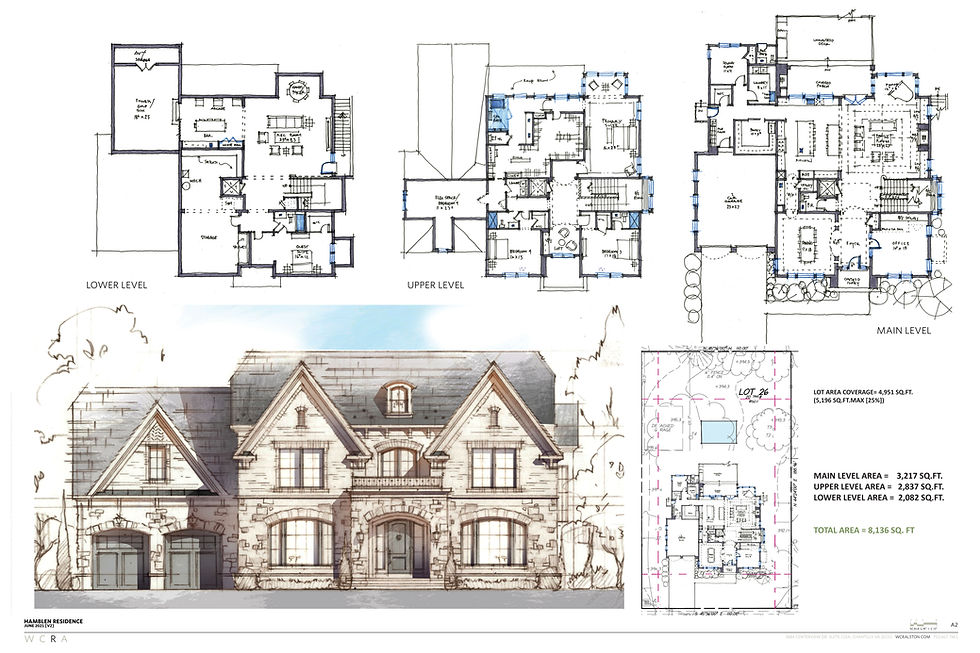
The Decisions That Cannot Be Undone
Every construction project has a hierarchy of decisions. Some can be changed cheaply and late — paint color, hardware, soft furnishings. Others can be changed expensively and with difficulty — cabinetry, plumbing locations, window placement. And some, once made, are effectively permanent for the life of the home — structural walls, ceiling heights, the orientation of the floor plan relative to natural light and landscape views.
The design industry's worst-kept secret is that most homeowners spend the most time on the first category and the least time on the third. They agonize over tile grout and spend fifteen minutes deciding where the windows go. This is not irrationality — it's a natural response to what feels concrete and what feels abstract at any given moment in the process. But it is expensive. A ceiling height decision made without understanding how the room will be furnished leaves a space that no amount of careful furniture selection can fully rescue. A kitchen oriented around the builder's standard layout rather than the actual sightlines of the home produces a friction that becomes background noise in daily life — noticed constantly, addressed never.
What an experienced designer brings to a new build in its earliest stages is the ability to make the abstract concrete. To read a floor plan not as a diagram but as a lived experience — to feel, on paper, where the light will fall at seven in the morning, where foot traffic will create conflict, where the open floor plan that looked generous in the architect's rendering will feel cold and undefined once furniture has to fill it. That translation — from plan to reality, before a single wall exists — is where the investment in early design involvement pays for itself most dramatically.
Why the Builder's Timeline Is Not Your Timeline
Builders in Northern Virginia operate on a schedule optimized for construction, not for design. Finish selections are due when the contractor needs them, not when a homeowner has had sufficient time to consider them within the context of the whole. The result is a process that feels collaborative but is structurally pressured — where decisions accumulate faster than most homeowners can thoughtfully make them, and where the path of least resistance is accepting the builder's standard option rather than specifying something better.
This pressure is not malicious. It is structural. And the homeowners who navigate it most successfully are the ones who arrived at the builder's table with a design plan already in hand — who had worked through their material palette, their fixture selections, their cabinetry profiles, and their lighting strategy before the builder's schedule demanded answers. In communities like Leesburg, Middleburg, and the newer developments across Loudoun County, where luxury new construction moves quickly and builder relationships favor clients who can make decisions efficiently, this preparation is not just an aesthetic advantage. It is a practical one.
The contrarian truth here is one that surprises even experienced homeowners: engaging a designer before the architect has finished the drawings is not premature. It is precisely the right moment. The decisions that feel most architectural — ceiling heights, window placement, the relationship between interior volumes — are also deeply interior decisions, and they benefit enormously from a designer's perspective before they are finalized. Changing a window location on a drawing costs nothing. Changing it after framing costs thousands.
Engaging a designer before the architect has finished the drawings is not premature. It is precisely the right moment.

What "Starting" Actually Means
When homeowners ask where to start on a custom new build, the question usually means: what do I do first? The more useful version of that question is: what do I need to understand before I do anything?
The answer, in almost every case, is how you actually live. Not how you imagine you might live in a beautiful new home, but how you genuinely move through a house on a Tuesday morning — where the coffee gets made, where the bags get dropped, where the family congregates without being asked to. The homes that feel most personal and most functional are not the ones with the most impressive specifications. They are the ones where every spatial decision was made in service of a specific family's specific life, and where the architecture and the interior design were developed together with that life as the reference point.
This is where luxury new construction in Northern Virginia is evolving most meaningfully. The homeowners building in McLean and Great Falls today are less interested in square footage as a statement and more interested in rooms that serve them with precision. The generous open floor plan is being reconsidered in favor of spaces that are open where openness serves the family and defined where definition supports how they actually want to live. Cozy living rooms designed for genuine gathering, not for scale. Primary suites that function as genuine retreats rather than impressive additions to the program. Art and statement pieces considered from the beginning of the design process, placed where the architecture supports them rather than hung wherever wall space remained after everything else was decided.
As House Beautiful and Architectural Digest have both reflected in recent coverage of luxury residential design, the most admired new homes of the past several years share a quality that is difficult to specify and immediately perceptible: they feel inevitable. As though every decision was always going to be exactly as it is. That quality is not accidental, and it is not the product of expensive materials alone. It is the product of a design process that began at the right moment, asked the right questions, and refused to let the builder's schedule make decisions that deserved more careful thought.
The Investment Case for Getting the Sequence Right
There is a financial argument for early design involvement in a new build that is separate from — and in some ways more persuasive than — the aesthetic one. Change orders are among the most expensive line items in any construction project, and the vast majority of them are the direct result of a decision that was made too quickly, without sufficient design context, and that needed to be revised once its implications became clear. A single structural change order on a significant Northern Virginia new build can easily exceed the cost of a designer's entire pre-construction involvement.
Beyond change orders, there is the quieter cost of decisions that don't get changed — that get lived with instead. The kitchen that functions adequately but was never quite right. The primary bathroom where the window placement made the freestanding tub position feel awkward. The foyer that doesn't make the statement the home deserves because its proportions were set before anyone considered what would happen in it. These are not catastrophic failures. They are the small, persistent compromises of a process that moved too fast in the moments that mattered most.
ASID has consistently made the case that professional design involvement in new construction generates measurable return — in avoided costs, in resale value, and in the quality of the daily lived experience. In the Northern Virginia luxury market, where properties represent significant investments and homeowners have real expectations for the outcome, that case doesn't need much elaboration. It simply needs to be made early enough to act on.

Where to Begin
If you are planning a custom new build in Northern Virginia — or anywhere across the DMV — the place to begin is not with a builder's portfolio or a floor plan catalog. It is with a design conversation that happens before any of that, while the project is still entirely flexible and every consequential decision is still available to be made well.
At DuVäl Design, we work exclusively on new builds and complex renovations, and we are most valuable to our clients when we are part of the process from its earliest stages. We work with homeowners across McLean, Great Falls, Vienna, Leesburg, and the broader Northern Virginia, Maryland, and Washington DC region — as well as the East Coast — who understand that the home they want is a product of decisions made in the right order, at the right moment, with the right expertise in the room. If that is the home you are trying to build, we would welcome the conversation. Reach out to DuVäl Design today!
See our portfolio: https://www.duvalreynolds.com/work
Follow us on Instagram: @duvaldesignllc


Comments